from: Furniture
Delaware Valley Walnut Armchair, 1755-1775
Delaware Valley Walnut Armchair, 1755-1775
Couldn't load pickup availability
Armchair.
Delaware Valley, 1755-1775 and later.
Walnut.
38" x 31" W x 23".
Descriptions by the Leading Expert of American Furniture, Dr. Philip Zimmerman, former Senior Curator and Head of the Museum at the Winterthur.
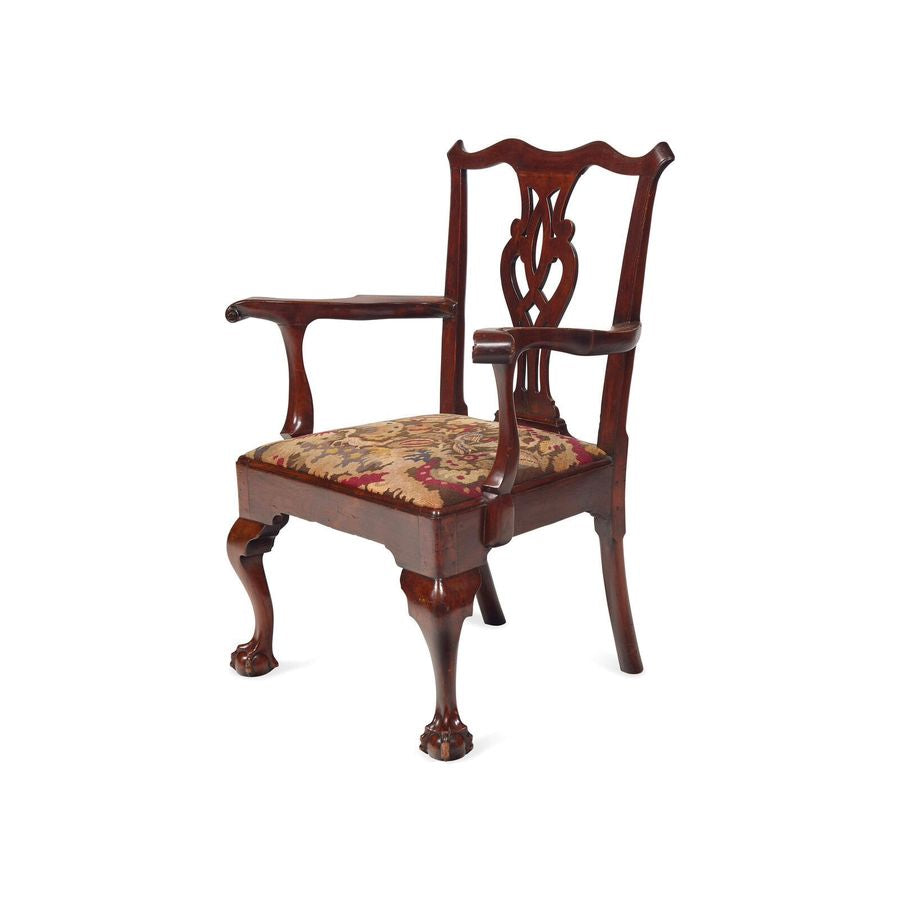
The armchair has a pierced strapwork splat of the Chippendale style below a serpentine crest rail. It stands on front cabriole legs ending in claw and ball feet. The rounded or “stump” rear legs show through tenons of the side rails, both that construction and the rear leg shaping being strong regional characteristics. The front and side rails are undercut to lighten their appearance.
The chair has the enlarged size of an armchair—especially notable in its broader width, but the height is out of proportion, being too low. This difference is the consequence of repairs to the chair. The splat design is in keeping with the design features of the rest of the chair, but it alone exhibits damage: the left side once split off from the rest of the splat. Minor repairs are evident. The shoe has only a modest split in the back, which is not consistent with the complete separation at the base of the splat. Given size of the splat relative to the rest of the chair, it appears to have come from another source. The crest rail was newly created to fit the shorter splat to the larger dimensions of this chair. Specifically, a taller splat, in keeping with the larger chair form, would have positioned the crest rail higher, thus joining the angled rear stiles farther away from the center.
The arms and arm supports are also replacements. Their shape is generally correct for the time, but small details indicate later fabrication. They include contours and massing. For example, the arm support rises to a thin neck. Although at first glance, this feature seems replicated in period examples, it is too thin, especially in comparison to the bulky massing of the join with the arm itself. Overly big changes in massing also exist between the curved section of the arm just behind the arm support and the massive handhold. The curved shape of the handhold is generally appropriate, but not in combination with the detailed volutes carved into both faces. Plain handholds have much simpler volutes. At the intersection of the back of the arm and the rear stile, the two surfaces incline downward toward the center of the chair.
Typically, they are level. The arm support exhibits similar divergences where it abuts the side rails. Also, the fit between it and the side rail is slightly off.
The four legs once stood off the floor on casters or some kind of metal glide that protected the bottoms of the feet.
At a later date, three wood blocks were glued to the insides of the seat rails. Screws passing through them secured the slip seat in place. Such glue-block additions to accommodate fixing of the slip seat is not an 18th century practice.