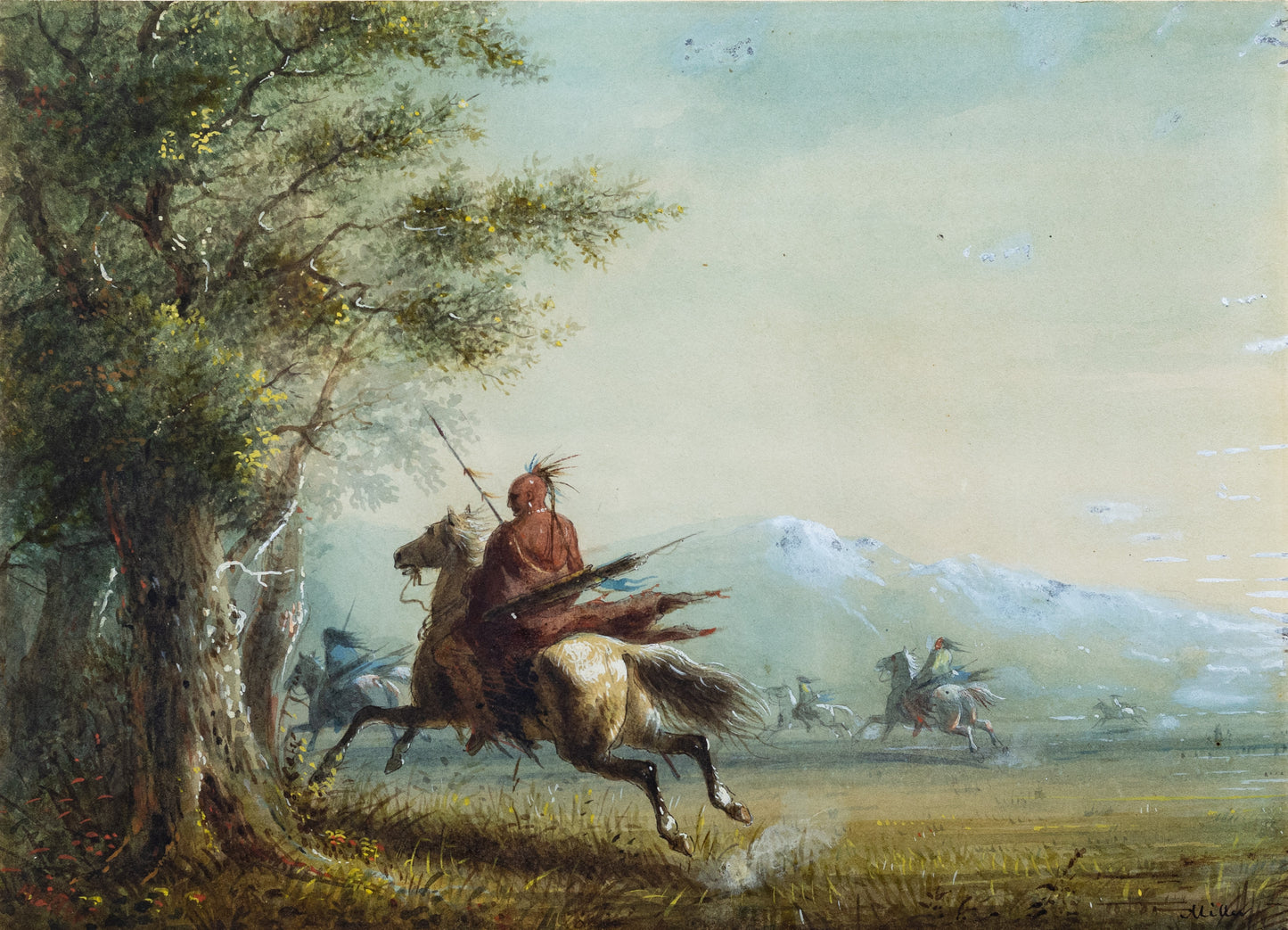
from: Alfred Jacob Miller
MILLER, Alfred Jacob (1857-1926) Indians in Pursuit C. 1838
MILLER, Alfred Jacob (1857-1926) Indians in Pursuit C. 1838
Couldn't load pickup availability
Alfred Jacob Miller (1810–1874)
Indians in Pursuit
signed (lower right)
watercolor on paper
c. 1838
8 1/2” x 11 1/2” sight; 16” x 19” framed
Alfred Jacob Miller, born in Baltimore on January 2, 1810, to George Washington Miller and Harriet Jacob, was one of the earliest trained artists to cross the Great Plains. Following study in Paris and Rome in 1833, the young Miller returned to Baltimore and established a studio. After his parents died, Miller left Baltimore and moved to New Orleans in the spring of 1837.
That is where he met Capt. William Drummond Stewart, the second son of Scottish nobility, veteran of the Napoleonic Wars, sportsman, and a seasoned traveler who had attended the annual rendezvous of fur trappers and traders in the Rocky Mountains on several occasions. Stewart planned to attend the 1837 rendezvous and, thinking that it might be his last, employed young Miller to document the trip.
Miller arrived in St. Louis in April 1837. There he visited with Gov. William Clark, the prominent explorer and superintendent of Indian Affairs, and spent time in Clark's museum in preparation for the trip. Stewart and Miller left Westport in May, along with forty five men and twenty carts loaded with trade goods to exchange for pelts at the rendezvous. They followed the Kansas and Little Blue Rivers to the Platte River, with Miller documenting every segment of the trip. They took the North Fork of the Platte past Chimney Rock, Scotts Bluff, and Fort Laramie, all of which Miller rendered in colorful watercolor. He also depicted Independence Rock, Devils Gate, Split Rock on the Sweetwater River, and the Continental Divide, arriving, finally, at Horse Creek in the Wind River Mountains, where trappers and Indians had gathered for the 1837 rendezvous.
Miller remained at the rendezvous for about three weeks. Following another couple of weeks hunting in the mountains with Stewart, Miller returned to New Orleans to begin working on the paintings that Stewart had commissioned. Stewart, meanwhile, had learned that his older brother John had died, that he had inherited the family estates and titles, and that he must soon return to Murthly Castle, the family estate just outside of Perth, Scotland.
Miller had made dozens of sketches. From them he first prepared a small album of eighty-seven wash and watercolor sketches for Stewart and then set to work on several large oil paintings that Stewart intended as decoration for Murthly. Stewart loaned eighteen of Miller's oils to the Apollo Gallery in New York for exhibition from May to July 1839 before shipping them to Scotland. Miller accepted Stewart's invitation to come to Murthly to continue his painting and remained there for approximately a year, painting both western and religious scenes. He returned to Baltimore in the spring of 1842 and spent the remainder of his life there.
The 1837 trip was the only western journey that Miller made, but he kept his field sketches and continued to fulfill commissions from them throughout his life. The most notable commission was that of William T. Walters, who ordered 200 watercolors from 1858 to 1860. Miller also sold several paintings to Charles Wilkins Weber that were chromo-lithographed for his books, The Hunter-Naturalist: Romance of Sporting; or, Wild Scenes and Wild Hunters and The Hunter-Naturalist: Wild Scenes and Song-Birds.
Miller saw the West through the lens of the romantic artist, depicting the many Indians at the rendezvous as noble savages and the Plains and mountains as a garden.
For Miller, the depiction of Indians on horseback represented the natives in their most charismatic form. Miller writes “one cannot fail to be impressed with their admirable horsemanship, and that such subjects originally gave birth to the conception of the fabled Centaur” The West of Alfred Jacob Miller (1837). It is unsurprising then that the image of a power Sioux warrior gliding through the plains on a majestic white horse, as is found in Indians in Pursuit, was a popular subject in Miller’s oeuvre. The present work bares resemblance to the Museum of Fine Arts Boston’s On the Warpath (right), though more developed and with slight compositional amendments. While the forefront figure remains similar, the secondary figures have been spread further apart and reduced in size so as to not take away from the protagonist. Notably a framing tree has been introduced to the left margin to better ground the scene and inject suspense into the vignette. These adjustments appear nearly identically in Sioux Reconnoitreing, commissioned for William T. Walters (1858–1860) and now in the Walters Art Museum.