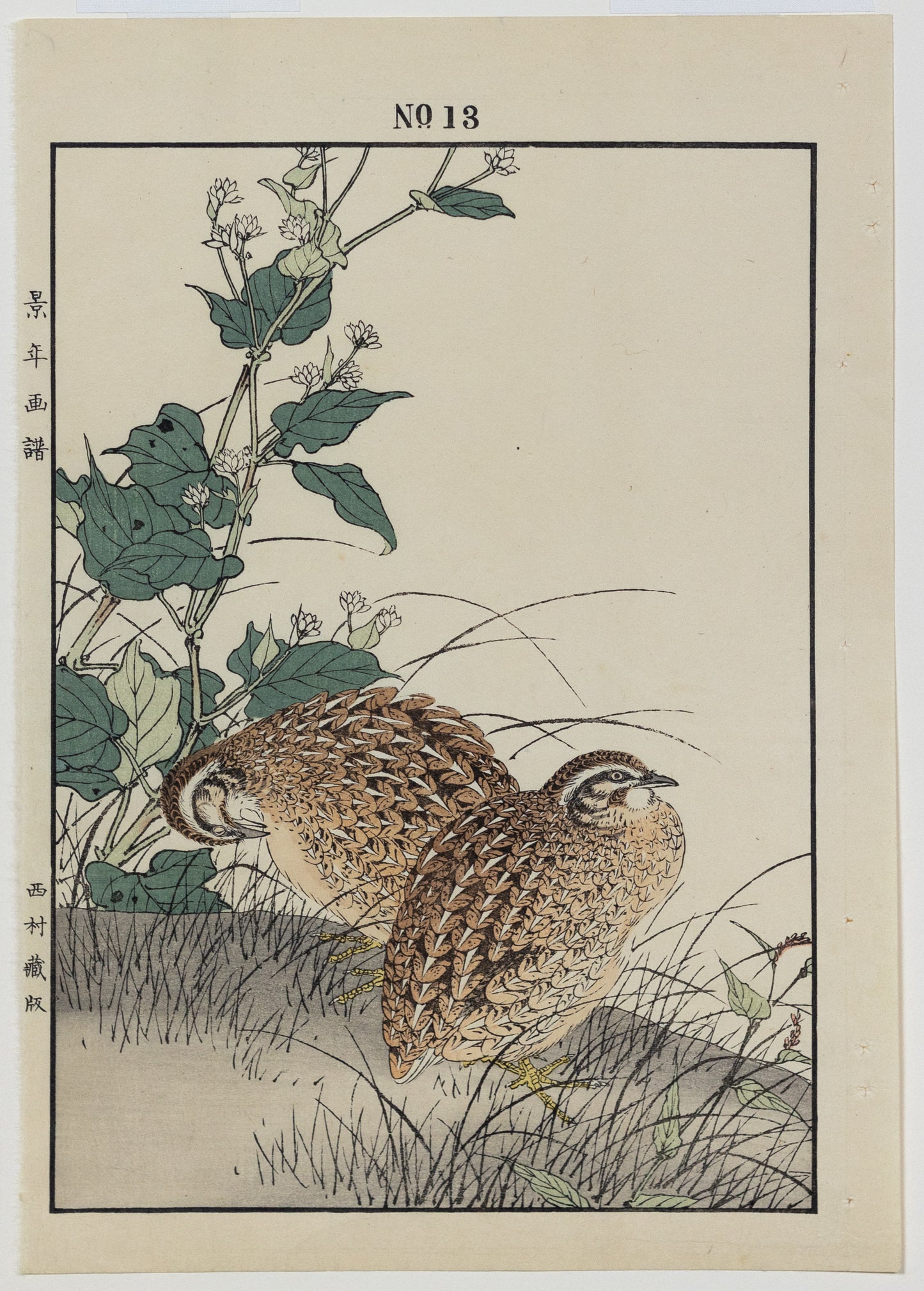
from: IMAO, Keinen (1845-1924) Keinen Kacho Gafu (trans. Keinen’s Flower-and-Bird Painting)
IMAO, Keinen (1845 -1924) Quail, Saggitarius, No. 13 (Autumn)
IMAO, Keinen (1845 -1924) Quail, Saggitarius, No. 13 (Autumn)
Couldn't load pickup availability
IMAO, Keinen (1845-1924)
Quail, Saggitarius, No. 13 (Autumn)
From: Keinen Kacho Gafu (trans. Keinen’s Flower-and-Bird Painting)Kyoto, 1891
14 1/2" x 10"
Seasonal woodblock prints from Keinen Kacho Gafu, a popularized kacho-ga
publications of the time, illustrated by Imao Keinen (1845-1924), a leader in the
Shin-Hanga movement.
Imao studied painting and calligraphy under ukiyo-e artist Umegawa Toukyo
and traditional ink painter Suzuki Hyakunen. He taught painting as a professor
at the Kyoto Prefecture School, starting in 1880, and soon grew to become one
of the most well known painters of his time, in large part due to his famed work
Keinen Kacho Gafu. Published first in 1891, these woodblock prints were released in sets of forty and in four volumes pertaining to a specific season, with
the blocks carved by Tanaka Hirokichi. Each print featured both striking large
birds and beautiful small songbirds set against scenery such as abundant chestnut trees or blossoming cherry branches. They were lauded for their naturalistic
presentation of birds in their native habitat with wonderful lifelike detail and
duly solidified Imao’s importance to Japanese art. Soon after their publication,
Imao was enlisted as a member of both the Imperial Household Art Committee
(1904) and the Imperial Art Academy (1919).
Keinen Kacho Gafu is closely linked to the realm of Japanese textile and was
used as a source for kimono design and decoration at the time. The book was
commissioned by Nishimura Sozaemon (1855-1935), a major textile producer
and trader in Kyoto specializing in embroidery and hand-painted yuzen. As did
many artists in Kyoto, Keinen supplemented his painting career by working
for Sozaemon in the laborious effort of painting yuzen textiles. Imao’s Keinen
Kacho Gafu was conceived and realized in close contact with the naturalist Yamamoto Akio and two renowned artisans, the carver Tanaka Jirokichi and the
printer Miki Jinzaburo. Keinen Kacho Gafu was published initially by Tanaka
Jihei, a Kyoto publisher who curated the printing, publication and distribution
though the ownership of the woodblocks always remained with Nishimura Sozaemon. Later in 1894, the publisher Unsodo acquired Tanaka Jihei’s stock and
publication rights and also reprinted the work with the original woodblocks,
recognizable by the replacement of Tanaka Jihei’s name with Unsodo’s own.