from: Engravings & Lithographs
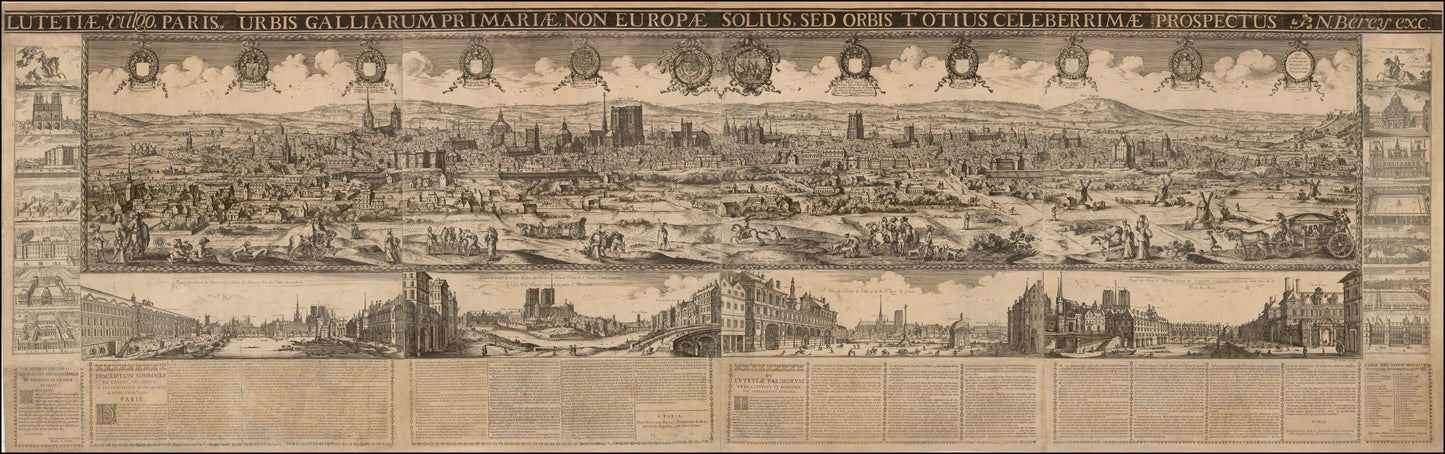
Berey, Nicolas after Noël Cochin. Lutetiæ, vulgo, Paris, urbis Galliarum primariæ, non Europæ solius, sed orbis totius celeberrimæ prospectus.
Berey, Nicolas after Noël Cochin. Lutetiæ, vulgo, Paris, urbis Galliarum primariæ, non Europæ solius, sed orbis totius celeberrimæ prospectus.
Couldn't load pickup availability
Berey, Nicolas after Noël Cochin. Lutetiæ, vulgo, Paris, urbis Galliarum primariæ, non Europæ solius, sed orbis totius celeberrimæ prospectus. Paris: Alexis-Hubert Jaillot, 1669. Third state.
Twenty-four sheets joined: 8 woodcut sheets for the title, 10 etched-engraved sheets for the view (the panorama in 4, detail views in 4, vignettes in 2), and 6 sheets of letterpress text. Framed: 36" x 101 ½". Visible: 94 5/8" x 29 ½". Backed on archival Japanese tissue. Tanned, particularly at the letterpress. Repaired chips and a small loss to the title-band. Facsimile repairs throughout the letterpress, particularly to the fifth and sixth columns of the French text and to the first column of the Latin text. Small facsimile to the left detail view ("Aspect Occidental du Pont neuf…"). A clean and rich impression.
Among the rarest large-scale views of early modern Paris ever produced, this extraordinary panorama — A prospect of Lutetia, commonly Paris, principal city of the French, most famous not only of Europe but of the whole world — stands as one of the defining monuments of seventeenth-century French printmaking. Drawn by Noël Cochin (1622–1695) and issued by the distinguished publishing house of Nicolas Berey along the quai des Augustins, the view captures the city at the precise moment of Louis XIV's ascendancy, just years after the young Sun King declared absolute monarchy following the death of Cardinal Mazarin in 1661.
Cochin's vantage point distinguishes the work from nearly all prior panoramas of the city. Where earlier masters such as Merian and Zeiller chose the heights of Belleville or Montmartre to the north, Cochin situates his eye further south and east, at Charonne, sweeping across Paris with an unprecedented breadth. The central panoramic view, engraved on four monumental sheets each measuring 20 ¾" x 16", extends nearly seven feet joined — a visual achievement that transforms the printed sheet into an immersive cityscape. Across the skyline, the major landmarks are named: the Bastille rises to the east, the Sorbonne and the dense cluster of Latin Quarter churches mass toward the center, the Louvre anchors the western edge, and the twin towers and soaring spire of Notre-Dame dominate all else.
The surrounding vignettes, detail views, and voluminous letterpress text in both French and Latin elevate the work well beyond mere topography into a visual encyclopedia of Parisian civic identity. Coats of arms belonging to the monarchy, the city of Paris, and leading municipal officials float above the skyline — and were gradually removed from successive states as their bearers died, left office, or fell from grace. The lower panels trace the history of the city from its first appearance as Lutetia in the writings of Julius Caesar through its growth across the succeeding centuries and reigns, accompanied by a numbered index keyed to the panorama.
The Berey family occupied a central position in the Parisian print trade. Nicolas Berey (1610–1665) operated Aux deux globes on the quai des Augustins — at the heart of the print dealers' district — and held the prestigious title of Enlumineur de la Reine alongside his son, Nicolas II. Upon the death of both father and son within six months of one another, the firm passed to Nicolas I's daughter Jeanne, whose husband Alexis-Hubert Jaillot (1632–1712) expanded the enterprise into a dynasty that would endure through the eighteenth century. It was under Jaillot's imprint that this, the third and rarest state of the view, was published in 1669 — the first to introduce textual revisions and subtle alterations to the subsidiary views, including the notable replacement of the Porte Neuve in the Louvre vignette with a staircase and fragmentary architectural elements, reflecting the gate's demolition between printings.
Surviving examples of the Lutetiæ prospectus in any state are exceedingly scarce. Only two examples — both of the first state — are recorded in American institutions: one at Princeton University Library and one at the Getty Research Institute. The Bibliothèque nationale de France is the sole institution recorded as holding the second and third states, each in a single example. The present impression, representing the rarest of the three states, offers a singular opportunity to acquire one of the great commemorative images of the Sun King's capital.
Boutier, Plans de Paris, 105C; Inventaire du fonds Français I.364. Not in Berty-Legrand.