from: Furniture
Desk and bookcase, Lancaster County, Pennsylvania, 1755-1795
Desk and bookcase, Lancaster County, Pennsylvania, 1755-1795
Couldn't load pickup availability
Desk and bookcase.
Lancaster County, Pennsylvania, 1755-1795.
Cherry tulip poplar, hard (i.e., yellow or resinous) pine, white pine.
77 1/4" x 40 1/4" W x 23 3/8".
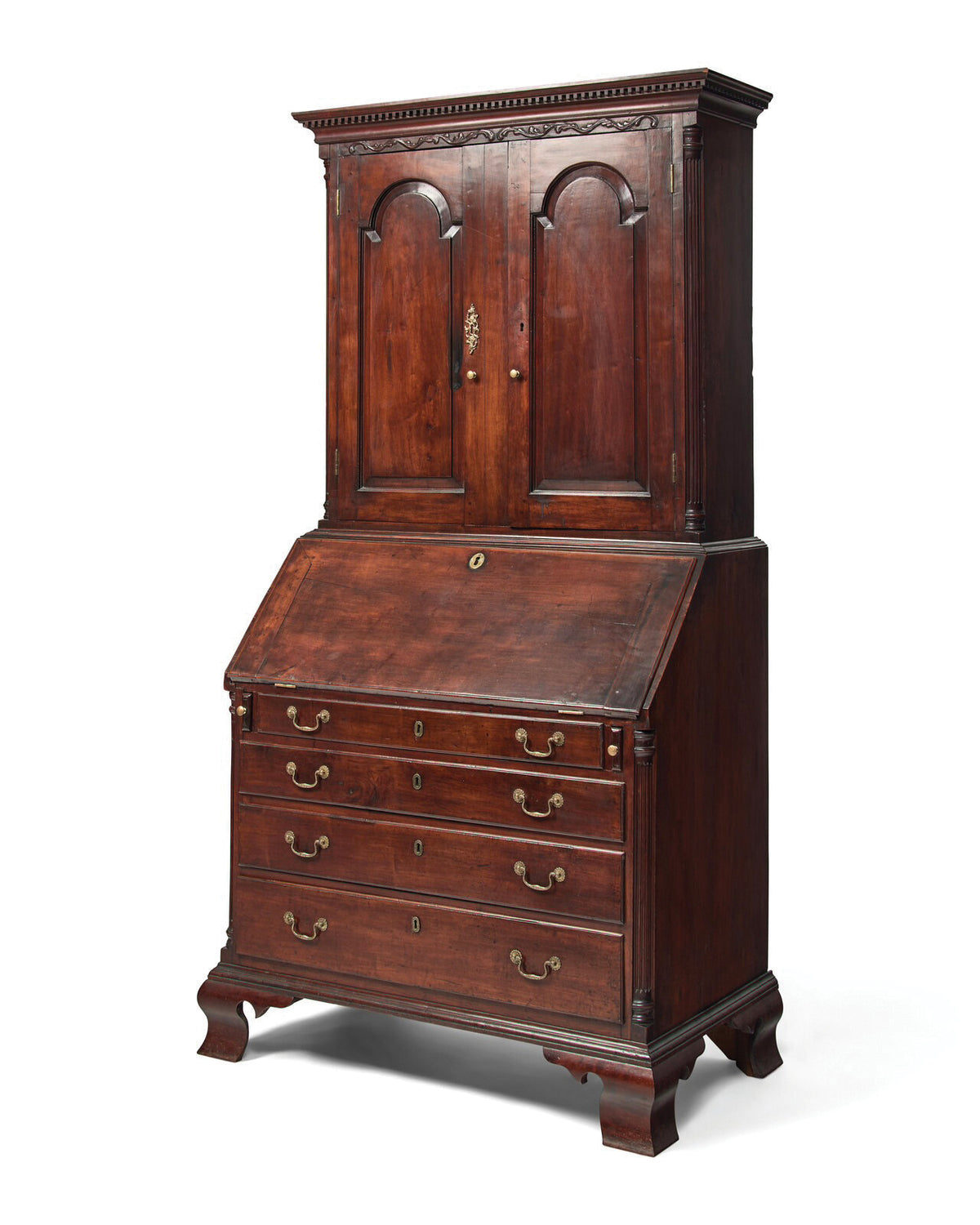
This desk and bookcase, made of cherry, a wood selected for its fine grain and resemblance to more expensive mahogany, has four graduated drawers in the desk section, each having full dustboards inside the case. The bookcase section rests on the top of the desk within a three sided molding attached to the desk.
The case piece is richly decorated. Its many features indicate an origin in Lancaster County, a geographical locale that was very populous in the late 18th century (Lancaster being the largest inland city in the colonies and early nation). It supported many furniture makers who produced many varied expressions. The makers and their work have not been adequately studied, and misidentifications continue. In the relatively recent past, Lancaster work has been identified as Connecticut, New Jersey, and elsewhere. This desk and bookcase, for example, had been called “likely” Salem County, New Jersey, because a pencil inscription of 1901 on the top of the removable prospect box recorded a history of ownership that began with John Gosling (1779- 1840), who is buried in Alloway, Salem County, New Jersey. If the provenance is correct, he was too to be the first owner, who may have been two generations earlier. Regardless, the object does not relate to any furniture documented from that area.
Several features tie the desk and bookcase to Lancaster furniture. Most indicative is the desk interior. A central “prospect” door between to applied half columns with large flame finials
bears elaborately foliated scrolls below a richly carved shell. The shell imitates four others, two on each side, that cap pairs of pigeonholes above a small, serpentine-shaped drawer. Although not particularly expressive of regional origin, the removable prospect box is of interest. It is locked in place by a wood spring lock at the outside center of the top. The box may be unlocked by depressing the wood tab through a small hole in the middle of the top drawer cavity. When removed, a back cover that slides into place may be removed to expose four half-depth drawers and two column drawers that slide into place behind the half-columns visible in the desk interior.
Of the rest of the desk and bookcase, the round-headed fielded panels of the bookcase doors may seem to be old fashioned for the rest of the object, but their use through the late 18th century is common in Lancaster furniture. Engaged quarter columns mark the front corners of the bookcase and desk sections, as was common in products of the greater Philadelphia region. The flat top of the bookcase is ornamented with a dentil course (with one missing dentil in the left front corner) above a cove molding. Below that, a carved foliate or acanthus vine occupies the uppermost rail (the board framing the top of the bookcase opening), transforming it into a kind of decorated frieze. This feature is very unusual and not fully understood. Its execution seems not as careful and capable as the work in the prospect door. Witness marks on the rail at each end show where the outer 2-1/2 inches have been removed and confirm that the carving is applied. Applied sections of carving are common in 18th century work, but they may raise the question of when the work was applied. That question is appropriate here.
Inside, the bookcase has a fixed shelf above a range of two side-by-side drawers along the bottom, each with front facades that imitate two side-by-side serpentine drawers, a configuration that echoes details of the desk. Each of these drawers appears to be a later replacement. The interior backs of the cherry drawer fronts especially look significantly newer than other drawers. Their parts and construction mimic that of the desk interior drawers, although molding planes do not match, and these drawers have white chalk assembly numbers in the inside corners whereas red chalk was used in the desk.
The bookcase doors have replaced hinges and repairs around them on the outside of the carcass and door frames. Similarly, the desk lid has replaced hinges that are larger than the original hinges. The inside of the lid has some surface repairs around the left hinge. It also has a small repair on the lower right edge. All of the brass pulls, escutcheons, and drawer pulls are replacements. The drawer brasses use one of two original holes. The original pulls were slightly wider but were likely post and bail, as these are, rather than pulls with decorative backplates. All of the feet have been replaced. The original feet were probably very similar. The cherry color looks early and very appropriate to this object. A dark mark in the left bookcase door immediately to the left of the door pull may have been caused by a flame, such as one from a candlestick, although there is no slide or other surface for one on this object.