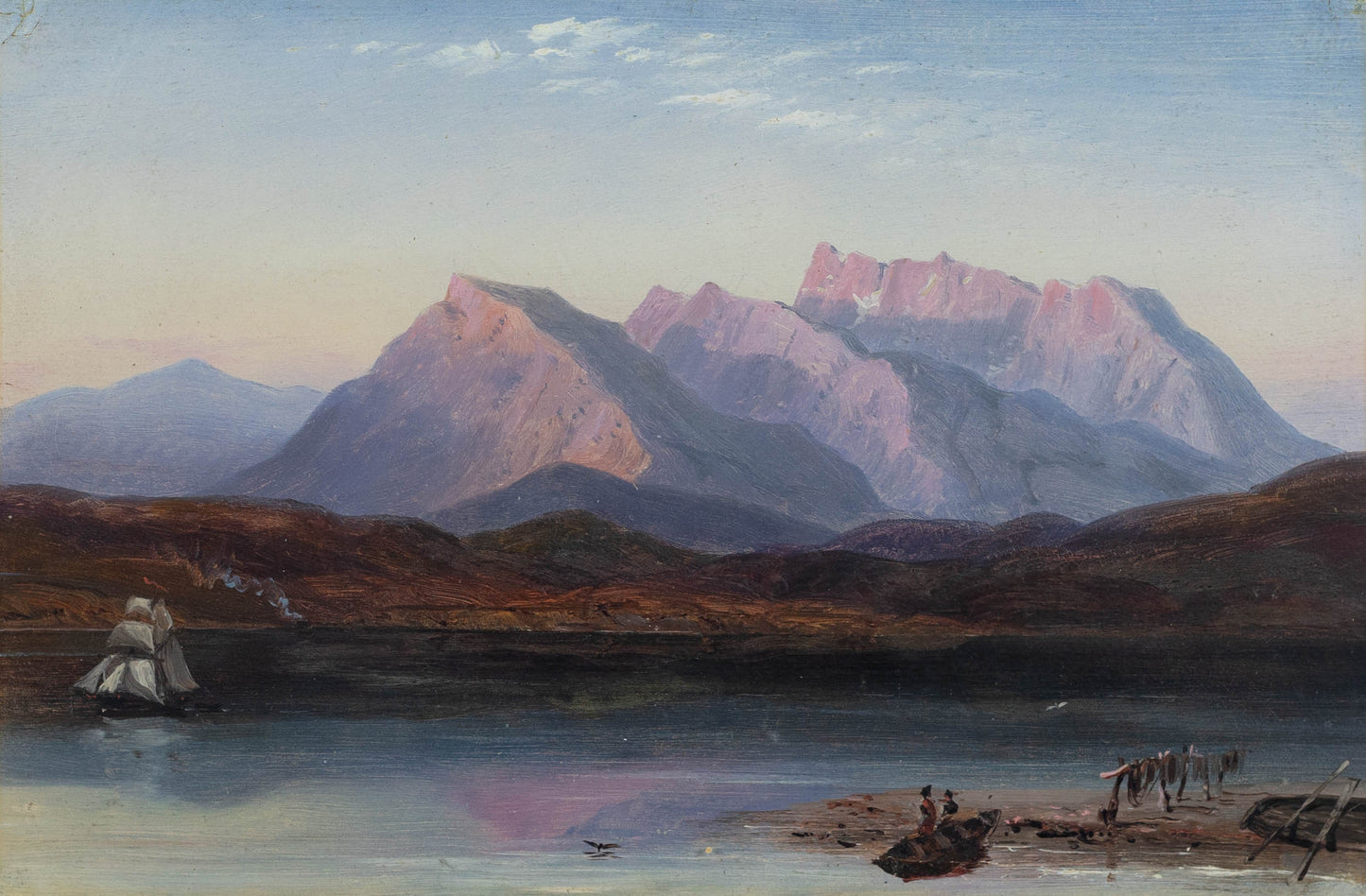
SMITH, Russell (Scottish-American, 1812-1896). Ben Nevis from the Calidonian’s Canal, a view of the ship Nevis
SMITH, Russell (Scottish-American, 1812-1896). Ben Nevis from the Calidonian’s Canal, a view of the ship Nevis
Couldn't load pickup availability
SMITH, Russell (Scottish-American, 1812-1896)
Ben Nevis from the Calidonian’s Canal, a view of the ship Nevis with mountain range in the distance
Signed verso “Russell Smith”.
Oil on paper
8 1/2” x 12” sheet
Russell Smith (Scottish American, 1812 to 1896)
Ben Nevis from the Caledonian Canal, with a view of the ship Nevis and the mountain range in the distance
Signed verso: Russell Smith
Oil on paper
Sheet size: 8 1/2 x 12 inches
This atmospheric landscape by Russell Smith presents a serene view of the Caledonian Canal with the great mass of Ben Nevis rising in the distance, its peaks rendered in soft violets and rose tones characteristic of Smith’s refined handling of light. At the water’s edge, the ship Nevis anchors the composition, balancing the sweeping Highlands scenery with a note of maritime activity. The delicacy of the brushwork and the quiet luminosity of the sky reflect Smith’s long engagement with both Scottish topography and American landscape traditions.
Born in Glasgow and later active in Philadelphia, Smith was a leading figure in mid nineteenth century landscape painting, producing works for the Pennsylvania Academy of the Fine Arts and serving as a favored topographical artist for scientific expeditions and railway surveys. His dual identity as a Scottish born American painter allowed him to bridge two visual worlds: the dramatic, mist toned Highlands of his youth and the expansive American scenery he encountered after emigrating. His Highland subjects, such as the present work, remained among his most personal and poetic images.
The Caledonian Canal and Ben Nevis held particular cultural resonance in the nineteenth century, symbolizing both the engineering ambitions of the era and the enduring romantic appeal of the Scottish landscape. Smith captures this duality with characteristic clarity, positioning manmade and natural elements in gentle harmony.
Executed on paper with a controlled, jewel like palette, this small scale oil exemplifies the intimate works Smith produced for collectors who admired his ability to translate large vistas into finely balanced compositions. It remains a compelling example of his Scottish themed landscapes, uniting geographical specificity with lyrical atmosphere.