from: Artists of the West 2026
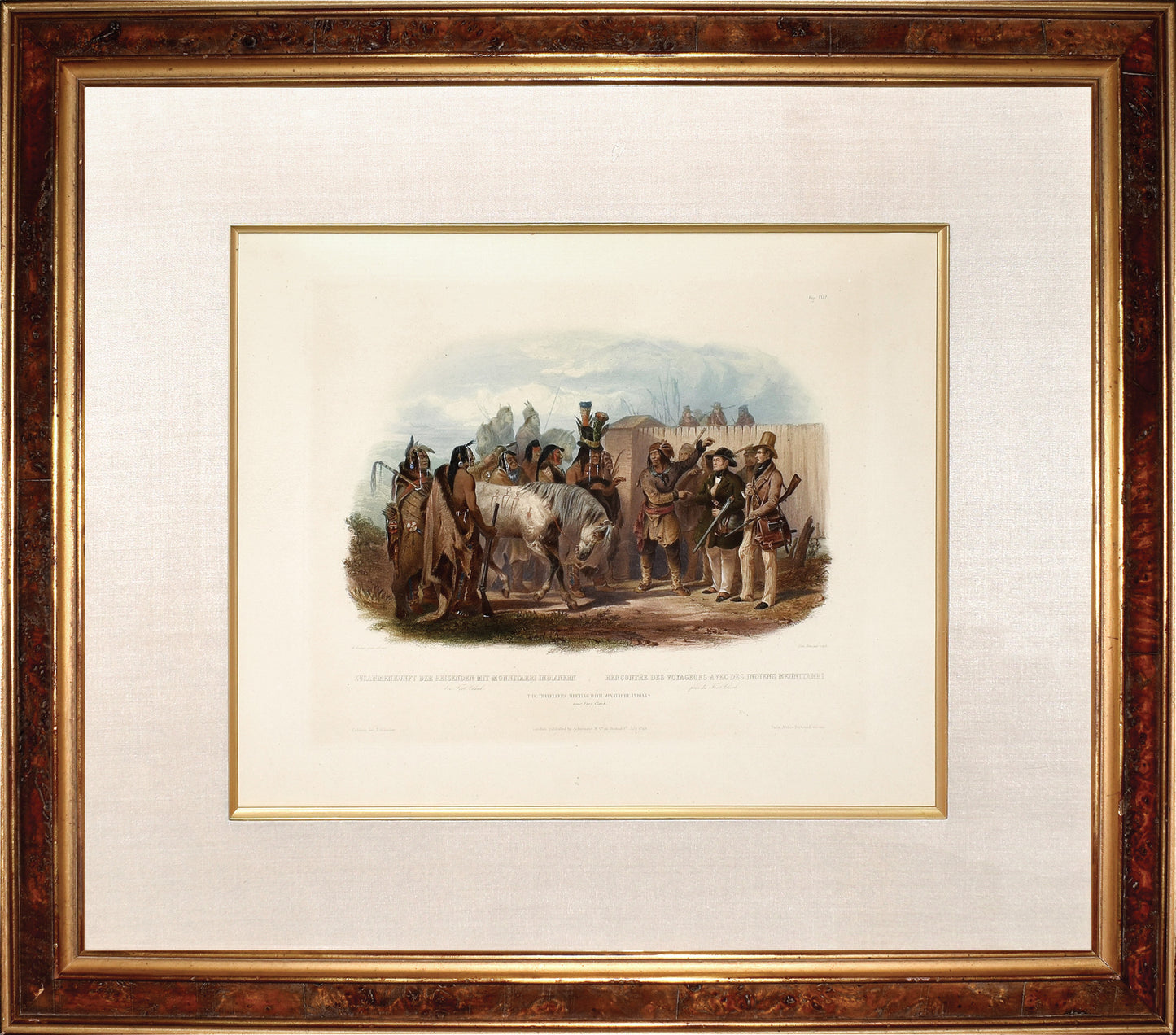
BODMER, Karl (1809-1893). Travellers meeting with Minatarre Indians, Vig. 26.
BODMER, Karl (1809-1893). Travellers meeting with Minatarre Indians, Vig. 26.
Couldn't load pickup availability
BODMER, Karl (1809-1893).
The Travellers meeting with Minatarre Indians, Vig. 26.
Aquatint engraving with original hand color.
From "Travels in the Interior of North America".
J. Holscher, Coblenz; Bertrand, Paris; Ackermann & Co., London: 1832-1843.
13 1/4" x 16 1/4" visible, 24 3/4" x 28 1/4" framed.
Karl Bodmer was a little-known Swiss painter when he was chosen by Prince Maximilian of Prussia to accompany his voyage to America. With the rest of Maximilian's company, the two traveled among the Plains Indians from 1832 to 1834, a time when the Plains and the Rockies were still virtually unknown. They arrived in the West before acculturation had begun to change the lives of the Indians, and Bodmer, who was a protege of the great naturalist von Humboldt, brought a trained ethnologist's eye to the task. The Bodmer/Maximilian collaboration produced a record of their expedition that is incontestably the finest early graphic study of the Plains tribes. These prints rank with the finest Western art in any medium, and they are the most complete record of the Plains Indians before the epidemics of the mid-19th century had decimated their numbers, and before the white man's expansion had taken their lands.
There is no mention in Maximilian's journal of a formal meeting with the Hidatsa at Fort Clark such as the one presented in Vignette XXVI. It was at Fort Clark and the nearby Mandan villages on 18 June 1833 that he and Bodmer first saw the Hidatsa, who had come to greet their steamboat. However, the HIdatsa made a much greater impression on the travelers the following day ("the most attractive sight which we had yet met with upon this voyage"), when the Yellow Stone stopped at the Hidatsa villages located on the Knife River several miles above Fort Clark. More than one hundred men, women, and children thronged around the ship, and the clothing, ornaments and horse gear of these handsome people dazzled the prince, who wrote, "Here my painter would have found the richest opportunity for his art. Unfortunately there was no time for drawing; but later that winter we did find some opportunity for this."